Military Antiques
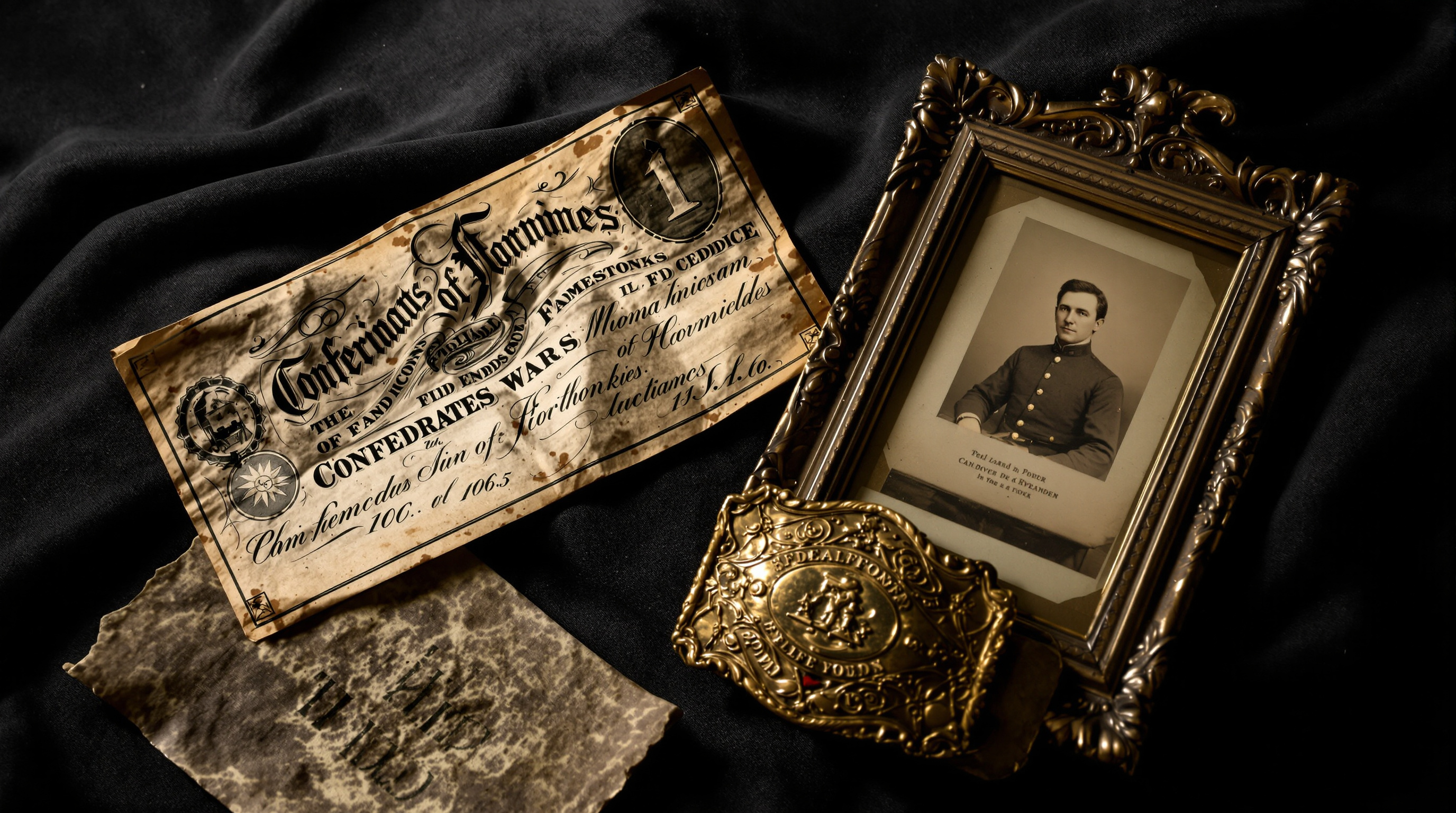
Gettysburg's battlefield history gives collectors a setting in which to study military antiques, especially Civil War material. Collectors can examine artifacts for connections to the soldiers, regiments, and events of the era. Compare a piece's markings and construction with reference examples before drawing conclusions about its history.
Civil War Militaria
Civil War accoutrements and personal items are useful categories for collectors to study. Examples of the kind of piece collectors look for include a regulation Union leather cap box with original straps and tab intact; a pair of Civil War sharpshooter's glasses with amber, frosted lenses and clear center dots for precise vision; an 1881 Mills US belt plate paired with an 1867–94 cartridge belt; and a matched set of Civil War-era ebony drum sticks. Ask a seller for notes on condition, markings, and provenance where known.
Confederate Currency & Numismatics
Confederate paper money is a perennial favorite, with denominations and issuing states providing ways to organize a collection. A representative piece — an 1862 Confederate $100 note stamped on the reverse "Interest paid to 17 January 1864 at Richmond" — illustrates the kind of well-documented, collectible note that collectors look for. Coins, tokens, and related numismatic material provide further subjects for study.
Images, Photographs & Paper
Original wartime imagery is among the most evocative material a collector can own. Cartes-de-visite (CDVs) of identified soldiers, period photographs, autographs, and historical documents are categories to compare when studying wartime imagery. An example of the kind of image collectors study is a seated CDV of a young Union soldier of Company A, 47th Massachusetts, kepi in hand, with a Cambridgeport & Lowell backmark. Printing artifacts are another collecting category, such as the original brass type-plate used for the front cover of Battles and Leaders of the Civil War.
Beyond the Civil War
While Gettysburg's history naturally draws Civil War material, a militaria collection can extend further. Spanish-American War and World War I-era books and photographs, Lincoln-related items, and European medals are further collecting subjects — including, for example, a mounted group of three German medals spanning the First and Second World Wars. For collectors building a broad militaria collection, comparing periods helps distinguish changes in design and use.
Collecting With Confidence
Authenticity and accurate description matter in militaria. Ask a seller how a piece was identified and what documentation supports the description. Reputable reference organizations such as the Smithsonian's National Museum of American History and the Gettysburg National Military Park history pages are valuable resources for collectors who want to deepen their knowledge before they buy.
Explore battlefield monument collectibles next, or review how to purchase and ship items.